
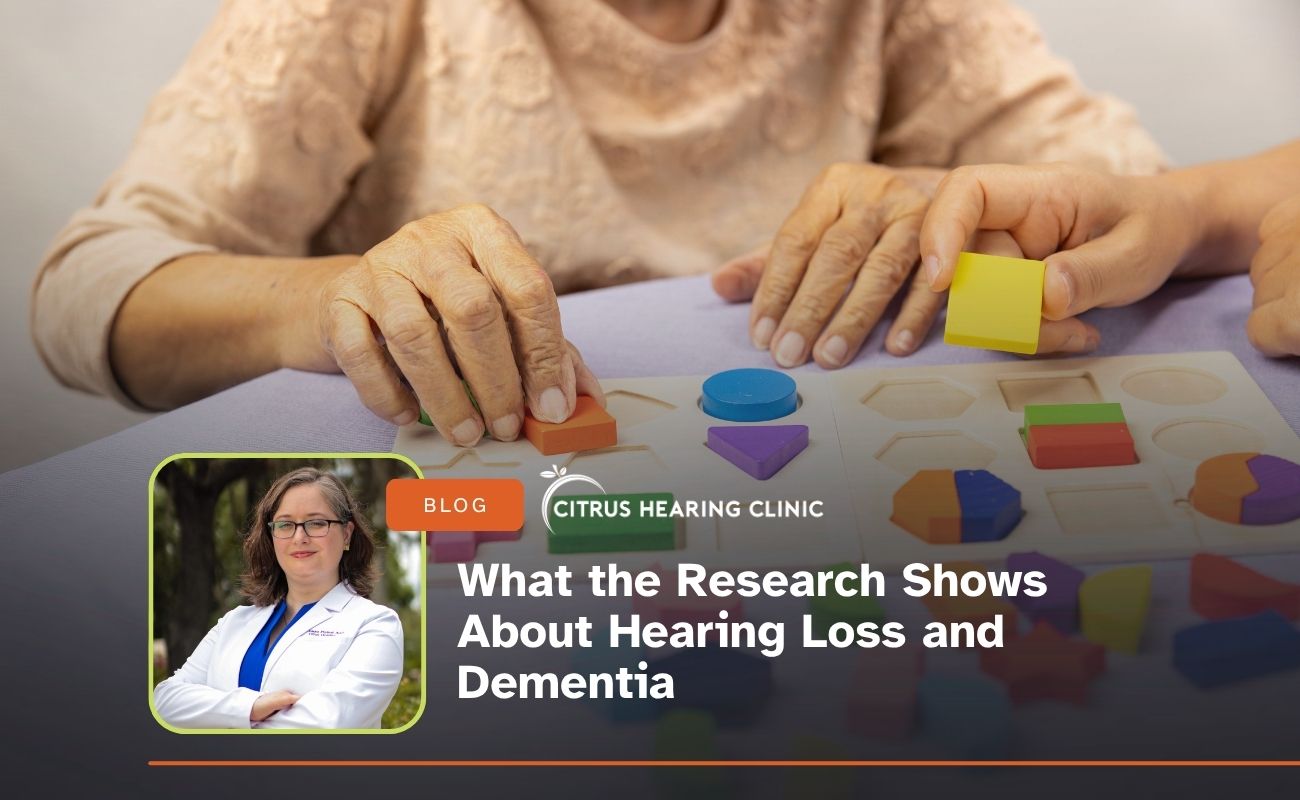
What the Research Shows About Hearing Loss and Dementia


If you've read a headline linking hearing loss to dementia and felt a little alarmed, you're not alone. It's one of the most searched topics in hearing health right now, and for good reason. The research is real but the way it gets summarized online often skips the nuance that actually matters for you and your family.
Here's what we know, what we don't, and why it's worth getting your hearing checked either way.
What the Dementia Research Points To
In 2024, the Lancet Commission on Dementia Prevention, Intervention, and Care updated its list of modifiable dementia risk factors to 14 total, including things like high blood pressure, smoking, diabetes, and social isolation. Hearing loss has consistently ranked among the largest of these factors, with some analyses estimating it plays a bigger role than any single other item on the list.
The commission's math is striking. Addressing all 14 modifiable risk factors, at a population level, could theoretically prevent or delay close to 45 percent of dementia cases worldwide. Hearing loss alone accounts for a meaningful chunk of that number.
That doesn't mean hearing loss causes dementia in a direct, one-to-one way. It means that across large populations, people with untreated hearing loss show up in dementia statistics more often than people with typical hearing. Association isn't causation, and the researchers behind this work are careful to say so. Still, an association this consistent, across this many studies and this many years, isn't something to wave off.
Why Your Ears Affect Your Memory
This is the part that trips people up, so let's slow down.
When your hearing is intact, your brain processes sound with relatively little effort. Speech comes in clear, your brain fills in the small gaps automatically, and you have plenty of mental bandwidth left over for actually following the conversation, remembering what was said, and responding.
Hearing loss changes that equation. Sounds arrive distorted or incomplete. Your brain has to work harder just to figure out what was said, before it can even get to the business of understanding and remembering it. Researchers call this cognitive load. Picture trying to read a book while a jackhammer runs outside your window. You can still do it, but nearly all your focus goes toward filtering out the noise, and there's less left for absorbing the story.
Over years, that constant strain seems to matter. There's also a second mechanism at play called auditory deprivation. The pathways in your brain responsible for processing sound need regular stimulation to stay sharp, the same way a muscle needs to be used to stay strong. When those pathways go under-stimulated for years, they don't just get quieter, they start to change structurally. This makes it progressively harder to understand speech, even in situations where hearing aids might otherwise help.
Add in the social piece. People with untreated hearing loss tend to withdraw from conversations, gatherings, and group activities because straining to hear all day is exhausting. Less social engagement is, on its own, a separate risk factor on the Lancet Commission's list. So hearing loss doesn't just affect the ears and the auditory pathways, it can chip away at the social connection that also protects the aging brain.
Researchers sometimes describe this as three overlapping pathways rather than one single mechanism. There's the direct cognitive load of straining to hear. There's the structural change in the brain from years of reduced auditory stimulation. And there's the indirect path through social withdrawal and isolation. Any one of these on its own might be manageable. Layered together over a decade or two, they start to add up in ways researchers are still working to fully untangle.
None of this happens overnight, either. Hearing loss is usually gradual, which is part of why so many people don't notice it, or don't act on it, until family members start pointing it out. That slow onset matters for the dementia conversation too, because it means the cognitive load and reduced stimulation described above tend to build quietly over years before anyone thinks to schedule a hearing test.
What the ACHIEVE Trial Showed
The largest clinical trial ever conducted on this question is the ACHIEVE study, published in 2023 and still the reference point for anyone asking whether treating hearing loss actually changes cognitive outcomes.
Nearly a thousand older adults with untreated hearing loss were randomly assigned to either receive hearing aids and audiologist support, or to a control group that got general health education instead. Researchers tracked their cognitive function over three years.
Across the full study group, the result was flat. Hearing aids didn't produce a statistically significant difference in cognitive decline for the average participant.
But within a specific, pre-planned subgroup, participants recruited from an older cohort already known to carry more cardiovascular and cognitive risk factors, the story changed. In that higher-risk group, cognitive decline slowed by roughly 48 percent over the three-year study period compared to the control group.
That's a real and meaningful finding. It's also a very specific one. The benefit didn't show up broadly across everyone with hearing loss. It showed up in people who already had elevated risk for cognitive decline to begin with. A 35-year-old with mild noise-induced hearing loss and no other risk factors is a different case entirely from a 78-year-old with hypertension, limited education, and a family history of dementia.
We're not going to tell you hearing aids prevent dementia. The evidence doesn't support that claim, and honestly, anyone who tells you it does is oversimplifying a genuinely complicated body of research. What the ACHIEVE trial does suggest is that for people who already carry other risk factors, treating hearing loss may be one useful piece of a larger prevention strategy, alongside managing blood pressure, staying socially active, and the rest of that same list.
It's also worth noting what the ACHIEVE researchers themselves said about their own results. They described the subgroup finding as encouraging and worth further investigation, not as proof of a broad cognitive benefit for every hearing aid wearer. That kind of restraint is exactly what you want from good science. A single trial, even a large well-designed one, rarely settles a question this complex on its own. Follow-up research is already underway to see whether these effects hold over longer periods, and whether certain patient groups benefit more than others.
What This Means for Your Next Step
Untreated hearing loss has real, well-documented downsides regardless of what it does or doesn't do to long-term dementia risk. It makes conversation harder. It contributes to isolation. It's tied to increased fall risk and higher rates of depression in older adults. Those are reasons enough to address it.
If dementia risk is part of what's motivating you to finally get your hearing checked, that's a completely reasonable reason to walk through our door. Just know it's one piece of a bigger picture, not a guarantee, and not something you should expect a hearing aid alone to fix.
A good starting point is understanding where your hearing actually stands. We put together a full guide covering the types of hearing loss, how it's diagnosed, and what treatment paths look like, including the research behind auditory deprivation in plain language. You can download our Hearing Loss Guide any time, no appointment needed.
Get Your Hearing Checked in Clermont
September is World Alzheimer's Month, which makes it a fitting time to think about the modifiable pieces of brain health you actually have some control over. Hearing is one of them, and it's also one of the easiest to check.
At Citrus Hearing Clinic, we're an independent, family-owned practice in historic downtown Clermont, and our doctors of audiology are hearing aid users themselves. We're not selling you on a miracle claim about dementia prevention. We're offering a thorough, unhurried hearing evaluation so you know exactly where you stand, and if treatment makes sense, we'll walk you through real options without pressure toward any particular brand.
If it's been a couple of years since your last hearing test, or if conversations have started feeling like more work than they used to, give us a call at 352-989-5123 to schedule your evaluation. We listen, so you can hear, and think clearly too.

Other Blogs

Contact us
Clinic Location
Clermont, FL 34711
Opening Hours
Saturday - Sunday: Closed
